
Global Warming Forecasts - 2025
Water Shortages | Water Scarcity
2025. 5 billion
people expected to experience periodic water shortages. “Greater
variability in weather patterns along with higher temperatures may lead
to droughts and water shortages. Today [2007], 1.7 billion people —
about one-third of the world's population — live in places that have
periodic water shortages. That number is expected to increase to 5
billion by 2025.” (David Brown,
Washington Post Staff Writer, “As temperatures rise, health could
decline as scientists confront climate change, disease issues studied,” The
Washington Post, Washington,
DC, Monday, December 17, 2007, p. A07)
2025. United Nations
projects 2.7 billion people will face severe water shortages by 2025 if
consumption continues at current rates. “Recently the United
Nations said that 2.7 billion people would face severe water shortages
by 2025 if consumption continues at current rates.” Global warming
2025. (Fen
Montaigne, “Water Pressure,” republished from the pages of National
Geographic magazine, undated, retrieved Monday, March 1, 2010)
2025. United Nations
projects that by 2025 an estimated 1.8 billion people will live in areas
plagued by water scarcity. “According to the United Nations,
water use has grown at more than twice the rate of population increase
in the last century. By 2025, an estimated 1.8 billion people will live
in areas plagued by water scarcity, with two-thirds of the world's
population living in water-stressed regions as a result of use, growth,
and climate change.” Climate change 2025. (No author credited,
“Freshwater Crisis,” National
Geographic, undated,
retrieved Monday, March 1, 2010)
2025. 36 countries with 1.4 billion people
projected to be either freshwater scarce or cropland scarce. “Today,
experts consider 21 countries, with a combined population of about 600
million, to be either cropland or freshwater scarce. Owing to continuing
population growth, 36 countries, with about 1.4 billion people, are
projected to fall into this category by 2025.” (National
Intelligence Council, Global
Trends 2025: A Transformed World,
Government Printing Office, Washington, DC, November 2008, pp. viii,
51)
Which areas of the U.S. and the world are likely to suffer most from water scarcity due to climate change?
See a more detailed chronology of forecasts of global warming water impacts.
___________________________________________________
Increasing population is driving a whole series of train wrecks. (1)
Sandia National Laboratory
Albuquerque, New Mexico
___________________________________________________
Population 2025
2025. World population projected to reach 7.9 billion by 2025. 7,941,443,471. (U.S. Census Bureau, “Total Midyear Population for the World: 1950-2050,” International Data Base, updated June 28, 2010, retrieved July 21, 2010)
2025. U.S. Census Bureau projects U.S. population to reach 357 million by 2025. 357,452,000. (U.S. Census Bureau, "Projections of the Population and Components of Change for the United States: 2010 to 2050," National Population Projections, Released 2008, Based on Census 2000, Population Division, 866-758-1060, Washington, DC, retrieved August 27, 2010)
2025. U.S.
population projected to reach 350 million by 2025. “[U.S.
population exceeded 300 million in 2006, and we are on track to hit 350
million in the next 15 years [2025].” (Bruce Katz and Judith Rodin, “An
impending national transformation,” Politico, Capitol News Company LLC,
Arlington, Virginia, May 9, 2010)
Water Scarcity | Water Supply 2025
Projected Global Water Scarcity, 2025
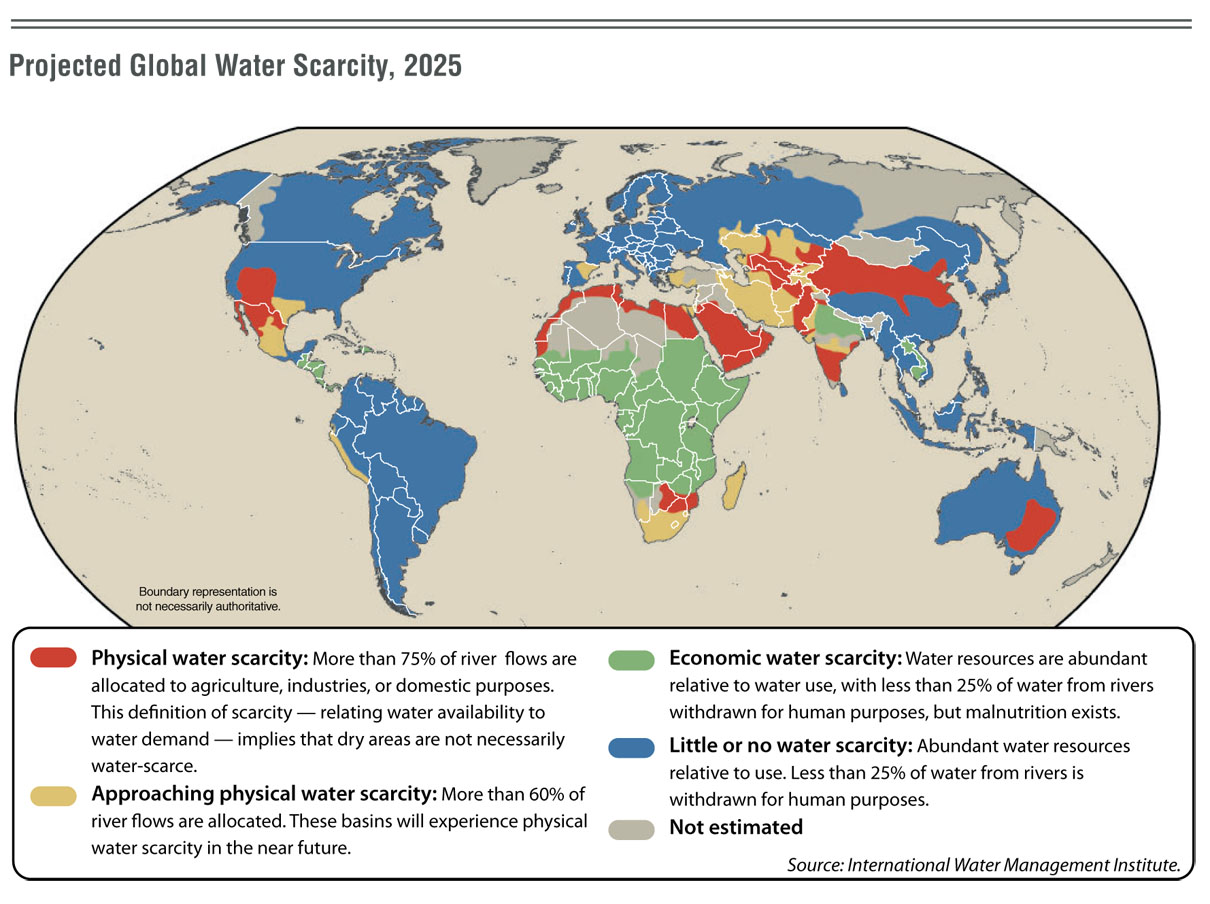

Source: National Intelligence Council, Global Trends 2025: A Transformed World, Government Printing Office, Washington, DC, November 2008, p. 55, water scarcity map adapted from the original map and research published by the International Water Management Institute, IWMI, Annual Report 2007-2008, p. 11)
Western U.S. - Potential Water Supply Crises Areas - 2025

2025. Water supply conflicts likely to occur in 2025 in the Western United States. “The map shows regions in the West where water supply conflicts are likely to occur by 2025 based on a combination of factors including population trends and potential endangered species’ needs for water. The red zones are where the conflicts are most likely to occur. This analysis does not factor in the effects of climate change, which is expected to exacerbate many of these already-identified issues. (Global Climate Change Impacts in the United States, Thomas R. Karl, Jerry M. Melillo, and Thomas C. Peterson, (eds.). U.S. Global Change Research Program, Cambridge University Press, 2009, p. 48 citing findings in U.S. Bureau of Reclamation, 2005: Water 2025: Preventing Crises and Conflict in the West. U.S. Bureau of Reclamation, Washington, DC, May 5, 2003, 32 pp. Updated from U.S. Bureau of Reclamation)
2025. Highest population growth to 2025 projected to occur in States with at risk water supplies caused by climate change. “The highest rates of [U.S.] population growth to 2025 are projected to occur in areas such as the Southwest that are at risk for reductions in water supplies due to climate change.” (Global
Climate Change Impacts in the United States, Thomas
R. Karl, Jerry
M. Melillo, and Thomas C. Peterson, (eds.). U.S. Global Change Research
Program, Cambridge University Press, 2009, p. 48 citing U.S. General Accounting Office, “Freshwater Supply: States’ Views of How Federal Agencies Could Help Them Meet the Challenges of Expected Shortages,” GAO-03-514. General Accounting Office, Washington, DC, July 2003, p. 57)
See a more comprehensive chronology of year-to-year forecasts of global warming water impacts.
1995-2025 High Population Growth Areas and Water Availability

Source: U.S. General Accounting Office, “Freshwater Supply: States’ Views of How Federal Agencies Could Help Them Meet the Challenges of Expected Shortages,” GAO-03-514. General Accounting Office, Washington, DC, July 2003, p. 58 applying data from the U.S. Census Bureau)
2025. Water-challenged California, New Mexico, Arizona, and Nevada projected to experience a population increase of more than 50 percent from 1995 to 2025. " The U.S. Bureau of the Census projects substantial population growth by 2025 in areas of the nation where demand is already stressing the water supply. This growth could threaten the water supply even further. . . . While the nation’s capacity for storing surface-water is limited and ground-water is being depleted, demands for freshwater are growing as the population increases, and pressures increase to keep water instream for fisheries, wildlife habitat, recreation, and scenic enjoyment. For example, ground-water supplies have been significantly depleted in many parts of the country, most notably in the High Plains aquifer underlying eight western states, which in some areas now holds less than half of the water held prior to commencement of ground-water pumping.
Meanwhile, according to Bureau of the Census projections, the southwestern states of California, New Mexico, Arizona, and Nevada, states that are already taxing their current water supplies, are each expected to see their population increase by more than 50 percent from 1995 to 2025. Furthermore, the potential effects of climate change create additional uncertainty about future water availability and use. For example, less snow pack as a result of climate change could harm states that rely extensively on melted snow runoff for their freshwater supply." (U.S. General Accounting Office, “Freshwater Supply: States’ Views of How Federal Agencies Could Help Them Meet the Challenges of Expected Shortages,” GAO-03-514. General Accounting Office, Washington, DC, July 2003, pp. 5, 56, 58)
2025. Projected population growth in the Nile River Basin could cut available per capita water supplies in half by 2025. “Consider the [Nile River], which might very well be the poster child for potential global water conflict. Rising in the high country of the Horn of East Africa, the Nile and its tributaries flow through nine countries before arriving in Egypt. The most populous and powerful of the nations along the Nile, Egypt is also last in line for its water.
‘The Nile River is shared by 10 countries, Egypt being the most downstream,’ Egyptian Minister of Water Resources Mahmoud Abu Zeid said in a 1998 interview in the Al-Ahram newspaper. ‘And those downstream get what is left after everyone else extracts what they want.’ That is why, without international cooperation and agreement, the Nile basin seems tailor-made for trouble. . . . On the Nile, for instance, projected population growth could cut available per capita water supplies in half by 2025, according to an analysis by a pair of Egyptian researchers published last year.” (John Fleck, Journal Staff Writer, “Sandia Sees Future Water Showdowns,” Albuquerque Journal, Albuquerque, New Mexico, June 25, 2006, p. B1)
See more comprehensive year-to-year forecasts of climate change and water resources.

Wildfires

"After accounting for differences in fire size, terrain, and road access, each additional home within one mile of a wildfire is associated with a $7,933 increase in suppression costs and each additional home within six miles is associated with a $1,240 increase." Source: Rasker, "Montana Wildfire Cost Study Technical Report," 2008, p. 11)
2025. By 2025
Montana's fire-suppression costs could triple to $84 million as result
of climate change and new development growth. “Climate change
and new development in Montana will cause fire-suppression costs to
skyrocket at the taxpayer’s expense if policymakers don’t better manage
fire-prone areas, a recently released report [Solutions to the Rising Costs of Fighting Fires in the Wildland-Urban Interface] says. . . . Headwaters Economics
conducted the study, which found that while it averages $28 million
each year to protect Montana homes near forestlands from wildfire, new
construction and global warming will fuel more fires and those costs
could triple [to $84 million] by 2025.
See a more comprehensive summary of global warming fire forecasts.
Heat Waves, Global
Warming 2025
2025. Stanford
study projects that intense heat waves are likely to occur as many as
five times between 2020 and 2029 over areas of the western and central
U.S. “Exceptionally long heat waves
and other hot events could become commonplace in the United States in
the next 30 years [2010 – 2039], according to a new study by Stanford
University climate scientists. ‘Using a large suite of climate model
experiments, we see a clear emergence of much more intense, hot
conditions in the U.S. within the next three decades,’ said Noah Diffenbaugh, an assistant professor of environmental Earth system science at Stanford and the lead author of the study. . . . The [study, Intensification of hot extremes in the United States], took two years to complete and is co-authored by Moetasim Ashfaq, a former Stanford postdoctoral fellow now at the Oak Ridge National Laboratory.
The study comes on the heels of a recent NASA report
that concluded that the previous decade, January 2000 to December 2009,
was the warmest on record. . . . ‘This was an unprecedented
experiment,’ Diffenbaugh said. ‘With the high-resolution [RegCM3]
climate model, we can analyze geographic quadrants that are only 15.5
miles [25 kilometers] to a side. No one has ever completed this kind of
climate analysis at such a high resolution.’ The results were
surprising.
According to the climate models, an intense heat
wave – equal to the longest on record from 1951 to 1999 [a period of 48
years] – is likely to occur as many as five times between 2020 and 2029
[a period of 9 years] over areas of the western and central United
States. . . .
Besides harming human health and agriculture, these hot, dry conditions
could lead to more droughts and wildfires in the near future, he said.
And many of these climate change impacts could occur within the next two
decades [2010-2030] -- years before the planet is likely to reach the
2-degree C threshold targeted by some governments and climate experts,
[Diffenbaugh] added.” (Mark Shwartz, communications manager, Woods Institute for the Environment
at Stanford University, “Heat waves and extremely high temperatures
could be commonplace in the U.S. by 2039, Stanford study finds,” Stanford Report, July 8, 2010 citing findings in Diffenbaugh, N., and M. Ashfaq. Intensification of hot extremes in the United States. Geophys. Res. Lett., (in press) DOI: 10.1029/2010GL043888, published August 6, 2010)
Number of Extremely Hot Seasons 2025 Decade (2020 - 2029)

Projected heat for U.S. 2020-2029 Source: Diffenbaugh and Ashfaq, Aug., 6, 2010
Heat wave impact and policy questions:
- Are new building codes being adopted
based on projected heat wave conditions or are decision-makers continuing to base them on the assumption of a continuation of historic weather and temperature patterns?
- How will exceptionally long heat waves impact peak power demand and new peaker power plant planning and construction assumptions?
- How will long, high intensity heat waves affect transmission line efficiencies?
- How will they affect power outage rates driven by higher air conditioning usage?
- How
will the volume of greenhouse gas emissions be affected by higher air
conditioning usage in heat wave regions where electricity is generated
from coal-fired power plants?
- How will high intensity heat waves impact water supplies and water consumption rates?
- What will be the impact of prolonged heat waves on crops, agricultural productivity and irrigation requirements?
- How will prolonged high intensity heat waves affect the availability of water for hydroelectric power
production?
- How will exceptionally long heat waves coinciding with predicted water shortages, impact the availability of water supplies for suppression of predicted wildfires?
- How will exceptionally long heat waves impact 'at-risk' elderly populations that have elected to retire in States impacted by intense heat waves?
- What percentage of homes in predicted severe heat wave areas will be without adequate air conditioning, backup protection or evacuation plans in the event of outages?
- How will these heat waves affect heat-related fatality rates and hospital personnel and infrastructure capacities to handle higher patient loads?
- How will they affect population migration patterns into or out of the high intensity heat wave States?
___________________________________________________
2025. 101 additional heat- and air pollution-related deaths projected for Seattle area in 2025 due to climate change. “Climate change in [the state of] Washington will likely lead to significantly more heat- and air pollution-related deaths throughout this century. Projected warming would likely result in 101 additional deaths among persons aged 45 and above during heat events in 2025 and 156 additional deaths in 2045 in the greater Seattle area alone [relative to 1980 – 2006]. By mid-century [2050], King County will likely experience 132 additional deaths between May and September annually due to worsened air quality caused by climate change." (Climate Impacts Group, 2009. The Washington Climate Change Impacts Assessment, M. McGuire Elsner, J. Littell, and L Whitely Binder (eds). Center for Science in the Earth System, Joint Institute for the Study of the Atmosphere and Oceans, University of Washington, Seattle, Washington, p. 2)
___________________________________________________
Temperatures 2025
2025. Global temperatures projected to increase by 2 degrees. “A U.N.-sponsored panel [the Intergovernmental Panel on Climate Change] of experts has concluded that worldwide temperatures will rise an unprecedented 2 degrees within 35 years [2025] and 5.4 degrees by the end of the next century if nothing is done to combat global warming. The forecast [Climate Change – The IPCC Scientific Assessment, 1990], issued Friday [May 25, 1990] in Britain, predicts that temperatures would be greater than any experienced in the past 10,000 years. Warming to that extent would raise sea levels 8 inches [20 centimeters] by the year 2030 and more than 2 feet by the end of the next century as ocean water expands and polar ice melts, the report said. The conclusions, based on the work of more than 300 climate experts from around the world, are said to represent the most exhaustive examination yet of the prospect for global warming.” (Michael Weisskopf and William Booth, Washington Post, “Study predicts 2-degree warming by 2025,” Austin American-Statesman, Austin, Texas, Saturday, May 26, 1990, p. A1)
Electric Power Supply and Global Warming
2025. U.S. electric power production highly likely to be limited by water shortages. “There is a high likelihood that water shortages will limit power plant electricity production in many regions. Future water constraints on electricity production in thermal power plants are projected for Arizona, Utah, Texas, Louisiana, Georgia, Alabama, Florida, California, Oregon, and Washington state by 2025. Additional parts of the United States could face similar constraints as a result of drought, growing populations, and increasing demand for water for various uses, at least seasonally.
Situations where the development of new power plants is being slowed down or halted due to inadequate cooling water are becoming more frequent throughout the nation." (Global Climate Change Impacts in the United States, Thomas R. Karl, Jerry M. Melillo, and Thomas C. Peterson, (eds.). U.S. Global Change Research Program, Cambridge University Press, 2009, p. 56 citing findings of Bull, S.R., D.E. Bilello, J. Ekmann, M.J. Sale, and D.K. Schmalzer, 2007: Effects of climate change on energy production and distribution in the United States, in Effects of Climate Change on Energy Production and Use in the United States, [Wilbanks, T.J., V. Bhatt, D.E. Bilello, S.R. Bull, J. Ekmann, W.C. Horak, Y.J. Huang, M.D. Levine, M.J. Sale, D.K. Schmalzer, and M.J. Scott (eds.)]. Synthesis and Assessment Product 4.5. U.S. Climate Change Science Program, Washington, DC, pp. 45-80)
2017. 50% chance that Lake Mead reservoir levels will drop
too low to allow hydroelectric power generation at Hoover Dam by 2017. “[In When will Lake Mead go dry?, a Scripps Institution of Oceanography study, research marine physicist Dr. Tim Barnett and climate scientist David Pierce
predicted] that there is a 50 percent chance that reservoir levels will
drop too low to allow hydroelectric power generation [at Hoover Dam] by
2017. The researchers add that even if water agencies follow their
current drought contingency plans, it might not be enough to counter
natural forces, especially if the region enters a period of sustained
drought and/or human-induced climate changes occur as currently
predicted. . . . ‘When expected changes due to global warming are
included as well, currently scheduled depletions are simply not
sustainable,’ wrote Barnett and Pierce in the paper.” (“Lake Mead Could Be Dry by 2021,” news release, Scripps Institution of Oceanography, University of California, San Diego, Tuesday, February 12, 2008 reporting findings in Tim P. Barnett and David W. Pierce, "When will Lake Mead go dry?," Scripps Institution of Oceanography, University of California San Diego, La Jolla, California, Journal of Water Resources Research, January 23, 2008)
See energy
workforce shortages.
2025. Despite energy efficiency trends total energy consumption will rise by about 50% over the period 2005 - 2025. “The single most important factor affecting the demand for energy will be global economic growth, particularly that of China and India. Despite the trend toward more efficient energy use, total energy consumed probably will rise by about 50 percent in the next two decades [2005 – 2025] compared to a 34 percent expansion from 1980-2000, with an increasing share provided by petroleum.” (“Growing Demands for Energy,” Mapping the Global Future - Report of the National Intelligence Council's 2020 Project - Based on Consultations With Non-Governmental Experts Around the World, NIC 200413, U.S. Government Printing Office, Pittsburgh, Pennsylvania, December 2004, p. 62)
___________________________________________________
“We were really surprised by these
huge straightforward [energy efficiency] opportunities that are not
being taken. In some senses, there is a big market failure.” (3)
McKinsey Global Institute
Commenting on the failure
of the marketplace to
capitalize on the cost savings
and profit-maximizing opportunities
of implementing energy
efficiency measures.
___________________________________________________
“I do believe we will be importing oil in 2025.” (4)
David O'Reilly
Retired Chairman and CEO of Chevron
___________________________________________________
Cleantech Greentech and Global Warming
2025. Distributed
energy and renewable micro-generation projects implemented by many small
economic actors offers the greatest possibility for overcoming the
energy infrastructure cost hurdle by 2025.
“Despite what are seen as long odds now, we cannot rule out the
possibility of an energy transition by 2025 that would avoid the costs
of an energy infrastructure overhaul. The greatest possibility for a
relatively quick and inexpensive transition during the period comes from
better renewable generation sources (photovoltaic and wind) and
improvements in battery technology.
With many of these
technologies, the infrastructure cost hurdle for individual projects
would be lower, enabling many small economic actors to develop their own
energy transformation projects that directly serve their
interests—e.g., stationary fuel cells powering homes and offices,
recharging plug-in hybrid autos, and selling energy back to the grid.
Also, energy conversion schemes—such as plans to generate hydrogen for
automotive fuel cells from electricity in the homeowner’s garage — could
avoid the need to develop complex hydrogen transportation
infrastructure.” (National Intelligence Council, Global Trends 2025: A Transformed World, Government Printing Office, Washington, DC, November 2008, p. viii)
Greenhouse Gas Emissions 2025
2025. Projected
starting point when melting permafrost begins a likely irreversible
release of 190 gigatons of greenhouse gases into the atmosphere. “Thawing permafrost
is threatening to overwhelm attempts to keep the planet from getting
too hot for human survival. Without major reductions in the use of
fossil fuels, as much as two-thirds of the world's gigantic storehouse
of frozen carbon could be released, a new study [Amount and timing of permafrost carbon release in response to climate warming]
reported. That would push global temperatures several degrees higher,
making large parts of the planet uninhabitable. Once the Arctic gets
warm enough, the carbon and methane emissions from thawing permafrost
will kick-start a feedback that will amplify the current warming rate,
says Kevin Schaefer, a scientist at the National Snow and Ice Data Center (NSIDC) in Boulder, Colorado."
"That will likely be irreversible. And we're less than 20 years [2030]
from this tipping point. Schaefer prefers to use the term ‘starting
point’ for when the 13 million square kilometres [11.6 million square
miles] of permafrost in Alaska, Canada, Siberia and parts of Europe
becomes a major new source of carbon emissions. ‘Our model projects a
starting point 15 to 20 years [2025 to 2030] from now ,’ Schaefer told IPS.
The model used a 'middle of the road' scenario with less fossil fuel
use than at present. Even at that rate, it found that between 29 and 60
percent of the world's permafrost will thaw, releasing an extra 190
gigatonnes of carbon by 2200. The study is the first to quantify when
and how much carbon will be released and was published this week
[February 15, 2011] in the meteorological journal Tellus.”
(Stephen Leahy, “Permafrost Melt Soon Irreversible Without Major Fossil
Fuel Cuts,” IPS, Uxbridge, Canada, February 17, 2011 reporting findings
in Kevin Schaefer, Tingjun Zhang, Lori Bruhwiler, Andrew P. Barrett, Amount and timing of permafrost carbon release in response to climate warming, Tellus B, 2011; DOI: 10.1111/j.1600-0889.2011.00527.x, article first published online on February 15, 2011)
2025. India’s greenhouse gas emissions could rise 70% by 2025. “India, though behind its Asian rival [China], could see greenhouse-gas emissions that rise 70% by 2025, according to the World Resources Institute. But the nearly double-digit growth rates that are responsible for those nightmare projections also present an environmental opportunity. ‘Anything you want to do about clean energy is easier to do from the outset,’ says David Moskowitz, an energy consultant who has advised Chinese officials. ‘Every time they [China] add a power plant or factory, they can add one cleaner and better than before.’
If China and India can muster the will and resources to leapfrog the West's energy-heavy development path, dangerous climate change might be averted. ‘China and India have to demonstrate to other countries that it is possible to develop in a sustainable way,’ says Yang Fuqiang, vice president of the Energy Foundation in Beijing. ‘We can't fail.’” (Bryan Walsh, “Global Warming: The Impact of Asia's Giants,” Time Magazine, Sunday, March 26, 2006)
2025. Higher air conditioning usage driven by higher temperatures projected to increase greenhouse gas emissions. “Global warming may lower energy bills in some places, but the air-conditioning bill in others is going to hurt worse, a study reports. In particular, the study [Responses of energy use to climate change: A climate modeling study] suggests turning on the air conditioner could make global warming worse because the electricity widely relies on coal power plants, which add warming ‘greenhouse’ gases to the atmosphere. The study, the first of its kind, looked ahead to changes in energy use and fossil fuel consumption nationwide through 2025. Led by Stanton Hadley of the Oak Ridge (Tenn.) National Laboratory, the researchers examined whether savings in winter heating bills might outweigh the added costs of summer air conditioning brought about by global warming. . . .
In the study, Hadley and colleagues combined a climate model, data from the National Climatic Data Center, Census projections and the Energy Department's economic model of the U.S. energy system to examine two possible futures. Global warming increased average global temperatures for 2025 3 degrees in one and 6 degrees in the other. Overall, the study found carbon dioxide emissions increasing more over time as coal is burned in Southern and Western states to power air conditioners during warmer and warmer summers. Meanwhile, New England states, while saving somewhat on energy bills, didn't have much warmer winters, the climate model shows.” (Dan Vergano, “Air conditioning fuels warming - Power use would eclipse energy savings from climate change,” USA Today, Arlington, Virginia, August 7, 2006, p. 6D citing findings in Stanton W. Hadley, David J. Erickson III, Jose Luis Hernandez, Christine Broniak and T. J. Blasing. “Responses of energy use to climate change: A climate modeling study,” Geophysical Research Letters, 33 17: L17703 September 1, 2006).
China and Climate Change 2025
___________________________________________________
“There is no solution to climate change without China.” (5)
___________________________________________________
Climate Change Winners
2025. Russia projected to be a climate change winner. “Russia has the potential to gain the most from increasingly temperate weather. Russia has vast untapped reserves of natural gas and oil in Siberia and also offshore in the Arctic, and warmer temperatures should make the reserves considerably more accessible. This would be a huge boon to the Russian economy, as presently 80 percent of the country’s exports and 32 percent of government revenues derive from the production of energy and raw materials. In addition, the opening of an Arctic waterway could provide economic and commercial advantages. However, Russia could be hurt by damaged infrastructure as the Arctic tundra melts and will need new technology to develop the region’s fossil energy.” (National
Intelligence Council, Global
Trends 2025: A Transformed World,
Government Printing Office, Washington, DC, November 2008, p. 52)
See permafrost forecasts for revised assessments of Russia's status as a climate change winner.
2025. Canada projected to benefit from climate change. “Canada will be spared several serious North American climate-related developments— intense hurricanes and withering heat waves—and climate change could open up millions of square miles to development. Access to the resource-rich Hudson Bay would be improved, and being a circumpolar power ringing a major portion of a warming Arctic could be a geopolitical and economic bonus. Additionally, agricultural growing seasons will lengthen, net energy demand for heating/cooling will likely drop, and forests will expand somewhat into the tundra. However, not all soil in Canada can take advantage of the change in growing season, and some forest products are already experiencing damage due to changes in pest infestation enabled by warmer climates.” (National Intelligence Council, Global Trends 2025: A Transformed World, Government Printing Office, Washington, DC, November 2008, p. 52)
___________________________________________________
What's surprising, and a bit worrisome, is that the [Greenland ice sheet] is melting so fast that we can actually see the land uplift in response. Even more surprising, the rise seems to be accelerating, implying that melting is accelerating. (2)
Rosenstiel School of Marine
and Atmospheric Science
___________________________________________________
Greenland Ice Sheet
2025. Greenland’s coastal lands projected to rise at a rate of 2 inches per year due to the melting of the Greenland ice sheet. “Scientists are astounded as rapid ice meltdown in Greenland is causing the land to rise quickly. Moving glaciers in Greenland form dense icecaps up to 2 km thick that covers most of the island. These icecaps also press down hard on the land beneath, lowering its elevation. Scientists from the University of Miami have now found that these icecaps are melting, causing some coastal lands to rise by nearly one inch per year. If this trend continues, that number could accelerate to as much as two inches per year by 2025, explains Tim Dixon, professor of geophysics at the University of Miami Rosenstiel School of Marine and Atmospheric Science (RSMAS) and principal investigator of the study.” (No author credited, “Greenland rapidly rising due to ice melting,” The Hindustan Times, London, England, May 19, 2010 citing findings in Yan Jiang, Timothy H. Dixon, Shimon Wdowinski, 'Accelerating uplift in the North Atlantic region as an indicator of ice loss', Nature Geoscience, May 2010; doi: 10.1038/ngeo845)
Permafrost Melting 2025
2025. Approximate
year when more carbon emissions will begin being outgassed from Arctic
permafrost than carbon is taken up by the tundra. “[S]cientists
have documented significant melting of the underground permafrost, from
Alaska to eastern Siberia. The rising temperatures [in the Arctic] have
lengthened the growing season of the Arctic summer, which has increased
plant growth and the consequent uptake of carbon dioxide. However, by
around 2025 this will go into reverse and the thawing permafrost will
release more carbon than is being taken up by the tundra growing above
it, [Dr. Kevin Schaefer of the U.S. National Snow and Ice Data Center
in Boulder, Colorado] said." (Steve Connor, Science Editor, “Melting
of the Arctic 'will accelerate climate change within 20 years', The Independent, Monday, May 30, 2011 reporting findings in Kevin Schaefer, Tingjun Zhang, Lori Bruhwiler, Andrew P. Barrett. Amount and timing of permafrost carbon release in response to climate warming, Tellus B, 63: 165–180. doi: 10.1111/j.1600-0889.2011.00527.x, Volume 63, Issue 2, pages 165–180, April 2011)
Rising Sea Level Global Warming 2025
2025. EPA predicts rise in sea levels of 2 feet by 2025.
“The doomsday headlines (Sunbelt Moving North, Warming Spells Disaster)
were unduly alarmist, and much of the information was well known to
scientists. But last week a media brouhaha was triggered by new studies
from the Environmental Protection Agency and the National Academy of
Sciences. Both groups agreed on a startling prognosis: the earth is
warming up from all the carbon dioxide being spilled into the
atmosphere by the burning of fossil fuels, and worse, the first effects
of the climatic changes could be felt as early as the 1990s. The EPA
predicted temperature increases of nearly 4° F by the year 2040; a rise
in sea levels of 2 feet by 2025 (thereby inundating some low-lying
areas in coastal cities such as Charleston, S.C., and Galveston,
Texas); and drastically changing rainfall patterns, especially in the
breadbasket areas of the Midwest, where reduced precipitation could
jeopardize crops. Nothing, not even a sharp cutback in the use of
fossil fuels, the EPA added, could alter this climatic course.”
Emphasis added. Global warming 2025. (Frederic Golden and Jay Branegan, “Environment: Hot Times for the Old
Orb,” Time Magazine, Monday, Oct. 31, 1983)
2025. Sea levels forecast to rise up to 10 inches by 2025 based on a 3 degree Fahrenheit rise in ocean temperatures.
“As global temperatures rise because of the greenhouse effect, oceans
levels expand by the warmer water temperatures and because of the
glacial melting, according to John S. Hoffman, director of EPA's Strategic Studies staff, which conducted [the Sea Level Rise Project].
The study provided two scenarios on the possible effects over the next
40 to 100 years. The low scenario, based on on the calculated
three-degree rise in ocean temperatures, will make the seas rise . . .
up to 10 inches by 2025. Such an increase by 2025 would be enough to
'significantly increase (storm and erosion) hazards at places like Ocean City [Maryland].' Hoffman said. . .
For barrier islands like Ocean City, according to Stephen P. Leatherman,
a University of Maryland coastal geographer who participated in the
research, the results would differ, depending on the scenario. 'Even
the rate of sea level rise in the low scenario would mean erosion
problems two or three times worse than what they (Ocean City) are
seeing now, and the high scenario would be almost catastrophic — at
least a major, major increase in storm hazards, there,' he said. One
big problem cited by Hoffman is that around the United States there are
already 1,137 active hazardous-waste disposal sites located in 100-year
floodplains, areas where major innundations should occur at least once
a century.” Climate change 2025. (Associated Press, "Greenhouse effect' may harm bay water,"
Frederick News-Post, Frederick, Maryland, May 2, 1983, p. 13)
2025. Maryland shoreline in Somerset County projected to be eroded back 17 feet with a 2 inch sea level rise by 2025. “In August [2008], consultants with URS Inc. presented a draft report [Somerset County, Maryland : Rising sea level guidance] on sea level rise to the Somerset County Planning and Zoning Commission. They predicted that by 2025 the shoreline will be eroded back some 17 feet across the board [with a sea level rise of 2 inches or 53 mm], increasing to 42 feet by 2050 and 92 feet by 2100. The greatest impact will be in the Deal Island and Chance communities, while Smith Island for the most part will be underwater just 90 years [2098 or ca. 2100] from now. . . .
The URS consultants are basing their report on historical data by predicting a 2 inch increase in average sea level by 2025, 5 inches by 2050 and one foot by 2100. [Somerset County Technical and Community Services Director Jack Willing Jr. ] said the state [of Maryland] is forecasting a two to three foot rise with four feet ‘the worst case scenario.’ He asked the consultants to modify their report accordingly. Kyle Gulbronson, the senior planner and project manager with URS, said four feet ‘is a doomsday scenario’ for much of the county. The effects "will be dramatic," he said.” (Richard Crumbacker, Crisfield Times, “Storm gives look into the future - Consultants predicted vulnerable areas, and high tide showed it,” Crisfield Times, Crisfield, Maryland, September 10, 2008, pp. 1, 3 reporting findings in URS & RCQuinn Consulting, Inc., "Somerset County, Maryland : Rising sea level guidance," a report to the Maryland Coastal Zone Management Program, Department of Natural Resources pursuant to NOAA Award No. NA05NOS4191142, September 24, 2008, p. 14)
2025. Sea levels projected to rise 1.5 inches to 3.1 inches by the year 2025.
“Sea levels may rise by 1.5 inches to 3.1 inches by the year 2025 from
expansion of ocean water in a warming climate, a prediction says. But
forecasting the total sea level rise will require estimating the
contribution of runoff from melting glaciers, ‘a daunting task,’
researchers said. The projected increase from thermal expansion,
calculated for 1985 to 2025, compares to previous published estimates of
2.3 inches to 4.3 inches, they said. The study [Thermal Expansion of Sea Water Associated with Global Warming] in the British journal Nature, was prepared by Tom Wigley and S.C.B. Raper of the University of East Anglia in Norwich, England. Mr. Wigley now is working at the National Center for Atmospheric Research
in Boulder, Colo. Changes in sea level are being studied as one
consequence of the ‘greenhouse effect,’ a warming of the global climate
due to a buildup of certain gases in the atmosphere.
Over the
last century, global average temperature has increased by about
nine-tenths of a degree Fahrenheit and sea level has risen by about 4 to
6 inches, the researchers wrote. But the relative contributions of
ocean water expansion and glacial melting are unknown and estimates vary
widely, they said.” (“Rise Forecast In Sea Levels By Year 2025,” The
Journal of Commerce, New York, New York, November 19, 1987, p. 10B
citing findings in Wigley, T.M.L. and Raper, S.C.B., 1987, “Thermal Expansion of Sea Water Associated with Global Warming,” Nature, 330, 127-131, 18 November 1987)
Agriculture, Food Supplies, Food Security
2025. Decreased agricultural output caused by global warming projected to have devastating impact on developing countries especially in Sub-Saharan Africa. “Climate change is expected to exacerbate resource scarcities. Although the impact of climate change will vary by region, a number of regions will begin to suffer harmful effects, particularly water scarcity and loss of agricultural production. Regional differences in agricultural production are likely to become more pronounced over time with declines disproportionately concentrated in developing countries, particularly those in Sub-Saharan Africa. Agricultural losses are expected to mount with substantial impacts forecast by most economists by late this century. For many developing countries, decreased agricultural output will be devastating because agriculture accounts for a large share of their economies and many of their citizens live close to subsistence levels.” (National Intelligence Council, Global Trends 2025: A Transformed World, Government Printing Office, Washington, DC, November 2008, p. viii)
2025. Population growth projected to cause 36 countries to be either cropland or freshwater scarce by 2025. “Lack of access to stable supplies of water is reaching critical proportions, particularly for agricultural purposes, and the problem will worsen because of rapid urbanization worldwide and the roughly 1.2 billion persons to be added over the next 20 years. Today [2008], experts consider 21 countries, with a combined population of about 600 million, to be either cropland or freshwater scarce. Owing to continuing population growth, 36 countries, with about 1.4 billion people, are projected to fall into this category by 2025.” (National Intelligence Council, Global Trends 2025: A Transformed World, Government Printing Office, Washington, DC, November 2008, p. viii)
Fisheries and Food 2025
2022. Projection that there will be no cod left by 2022 if cod fisheries continue to be fished at current rates. “Cod and other commercial ground fish are caught in a net in the Gulf of Maine. Our appetite for fish is wreaking havoc on aquatic populations worldwide. The conservation group World Wildlife Fund predicts that if cod fisheries continue to be fished at current rates, there will be no cod left by 2022.” (National Geographic editors, “Cod Caught in a Net, Gulf of Maine,” National Geographic, undated, retrieved Saturday, June 12, 2010)

2025. Dartmouth study projects that over 1 trillion bits of plastic will be released into the ocean from 2014-2024 due to the melting of Arctic ice. “In a study published in the open-access journal Earth’s Future, [Dr. Rachel Obbard, a Dartmouth University professor] and her colleagues write that more than a trillion bits of plastic may be released into the ocean over the next 10 years [2014-2014] as global warming speeds the melting of Arctic ice. . . . Obbard and her colleagues believe that micro-plastics typically land in the ocean in one of three ways: ‘One way is through laundry,’ she says: ‘The lint particles that come off in your washing machine and then get washed out with the water.’ A second type of particles results from fragmentation in the ocean of larger plastic waste such as water bottles and fishing nets. The last major source is probably waste from companies that use small plastic particles to manufacture larger items. According to the report ‘microplastic fragments . . . are clearly ingested by a wide range of marine organisms including commercially important species,’” (Business Week 2014, Caroline Winter, “How So Much Plastic Got Into the Frozen Arctic Sea,” Business Week, May 30, 2014 reporting findings in Earth’s Future 2014, Rachel W. Obbard et al, “Global warming releases microplastic legacy frozen in Arctic Sea ice,” Earth’s Future, DOI: 10.1002/2014EF000240, May 20, 2014)
Other Events, Forecasts and Projections Converging in 2025
Medical Care Workforce
2025. Shortage of U.S. physicians projected for 2025. “The United States faces a shortage of between 124,000 and 159,000 physicians by 2025. Already at least 22 states and 15 medical specialties have reported physician workforce shortages, including in medically underserved regions and front-line specialties including primary care and general surgery. . . . The American Medical Association (AMA) adopted today at its Annual Meeting new policies to strengthen the physician workforce to meet the nation's growing health care needs.” (American Medical Association, “AMA Works to Strengthen the Physician Workforce to Meet the Nation's Health Care Needs - U.S. Faces a Shortage of Between 124,000 and 159,000 Physicians by 2025,” PR Newswire, Chicago, Illinois, June 14, 2010)
2025. Severe shortage of nurses in the U.S. projected for 2025. “Patients should brace for a severe shortage of nurses, which could reach 500,000 by 2025, U.S. health researchers said. Peter Buerhaus of Vanderbilt University School of Nursing, Douglas Staiger of Dartmouth University and David Auerbach of the Congressional Budget Office said the demand for registered nurses is expected to continue to grow at 2 percent to 3 percent per year. The supply of registered nurses is expected to grow very little as large numbers of nurses begin to retire or leave work. By 2020, the U.S. shortage is estimated to be 285,000 full-time nurses and reach 500,000 by 2025.
Inadequate nurse staffing in hospitals is associated with reductions in hospital bed capacity, delays in the timeliness of patient care, longer length of stay by patients, interruptions in care delivery processes and increased risk of adverse patient outcomes including mortality, the researchers said in a statement.” (UPI News Service, “Patients should prepare for fewer nurses,” UPI Consumer Health Daily, March 28, 2008 citing findings in Peter I. Buerhaus, Douglas O. Staiger, and David I. Auerbach, “The Future of the Nursing Workforce in the United States: Data, Trends, and Implications,” Journal of the American Medical Association, JAMA. 2008;300(16):1950, Vol. 300 No. 16, October 22/29, 2008)
Disease
2025. Number of adults suffering from diabetes worldwide projected to reach 380 million by 2025. “The International Diabetes Foundation estimates there are 246 million adults worldwide suffering from diabetes today; by 2025, the figure is expected to reach 380 million.” (“Diabetes Reaching Epidemic Numbers Worldwide - New cases of diabetes in U.S. alone expected to double in next 25 years,” PR Newswire, Philadelphia, Pennsylvania, May 13, 2010)
2025. Annual worldwide tobacco-related death toll projected to reach at least 10 million by 2025. “Richard Peto, an epidemiologist at Oxford University's Imperial Cancer Research Fund, calculates that tobacco killed 3 million people in 1995, 1 million of whom lived in developing countries. By 2025, Peto estimates, tobacco's annual death toll will reach at least 10 million. More than 7 million of the victims will die in developing countries - a 700 percent increase in just one generation. If present trends continue, according to the World Bank's 1993 World Development Report, tobacco-related deaths will in 30 years' time exceed the death toll from tuberculosis, AIDS-related illnesses and complications in childbirth combined.” (Anne Platt Mcginn, “World-Wide Tobacco,” Greensboro News & Record, Greensboro, North Carolina, August 10, 1997, p. F1)
2025. By 2025 more and more people in developing nations projected to suffer tobacco-related deaths. “Smoking-related deaths around the world will more than triple in the next 25 years [1997 – 2022], and no other country will feel the burden as much as China, according to new data released yesterday at a U.N.-supported conference on tobacco control. More than three million smokers will die this year [1997], with most of the deaths coming from affluent nations. But by 2025, more and more people in developing nations will suffer tobacco-related deaths as smoking becomes more popular in poorer parts of the world, the conference reported.” (Jennifer Lin, Inquirer Staff Writer, “Smoking Deaths Predicted To Triple \ China And Developing Nations Will Be Hit Hardest, A U.N.-Backed Conference Said,” Philadelphia Inquirer, Philadelphia, Pennsylvania, August 25, 1997, p. A01)
China
2025. Year China could overtake the U.S. as the world’s biggest economic power. “China’s rocketing economy could overtake the US within 25 years, according to the author of a new book on the country. Oded Shenkar said China's mix of cheap but skilled workers, imported new technology and economies of scale made it very competitive and on course to be the biggest economic power about 20 years earlier than other analysts believed. He said: ‘The rise of China is a watershed. I compare it to the rise of the United States in the late 19th century.’” (“China 'biggest economy by 2025’,” The Evening Standard, London, England, February 9, 2005) Peruse books by Oded Shenkar.
Aging Population
2025. U.S. cities may not be able to support aging citizens if current trends continue. “Should these trends continue, America in 2025 may have cities that can't support their aging citizens; transportation infrastructure ill-equipped to meet the needs of young or old, and a gap between rich and poor that could grow with our population.” (Bruce Katz and Judith Rodin, “An impending national transformation,” Politico, Capitol News Company LLC, Arlington, Virginia, May 9, 2010)
Weather Forecasting
2025. Weather forecasts in the zero to 2-day time frame predicted to be essentially perfect.
“And what's the forecast for forecasting ordinary weather—the cold
fronts, drizzle, and sunshine that are the backdrop to most people's
lives? Steady improvement, says Richard Anthes, president of the University Corporation for Atmospheric Research
in Boulder. By 2025, he says, ‘numerical predictions in the zero to
two-day time frame will be essentially perfect. If the forecast says 12
inches [30 centimeters] of snow, the actual amount will be in the 10- to
14-inch [25- to 35-centimeter] range.’ Forecasts of temperatures and
storms a week out will be as reliable as two- to three-day forecasts are
today — which is to say, right most of the time.” (Tim Brookes, “How's
the Weather Out There? Forecasting the Chaos of Weather,” republished
from the pages of National Geographic magazine, undated, retrieved Thursday, May 20, 2010)
________________________________________________
(1) John Fleck, Journal Staff Writer, “Sandia Sees Future Water Showdowns,” Albuquerque Journal, Albuquerque, New Mexico, June 25, 2006, p. B1
(2) No author credited, “Greenland rapidly rising due to ice melting,” The
Hindustan Times, London,
England, May 19, 2010 citing findings in Yan Jiang, Timothy
H. Dixon, Shimon
Wdowinski, 'Accelerating
uplift in the North Atlantic region as an indicator of ice loss', Nature Geoscience, May 2010; doi: 10.1038/ngeo845
(3) Steve Lohr, “The Cost of
an Overheated Planet,” The
New York Times, December
12, 2006 citing findings reported in Florian Bressand, Diana Farrell,
Pedro Haas, Fabrice Morin, Scott Nyquist, Jaana Remes, Sebastian Roemer,
Matt Rogers, Jaeson Rosenfeld, Jonathan Woetzel, “Curbing
Global Energy Demand Growth: The Energy Productivity Opportunity,” McKinsey Global Institute, San
Francisco, California, May 17, 2007, p. 17
(4) Eric Wesoff, “Overview of the Energy Landscape From a Former Chevron CEO,” GreentechMedia.com, June 26, 2012
(5) Dr. Michael A. Levi, China Goes Global, China 2025 Conference, Co-sponsored by the Council on Foreign Relations and Project 2049, Washington DC, October 19, 2009
Don't forget to bookmark this page
Climate Change 2025 - Global Warming 2025